
A school trip, a camp cabin and a sleepover all have different limits: no cards, one shared phone, or a neighboring room that needs quiet. Start with the time and equipment you actually have, then pick a game that fits the room.
The twenty games below are grouped into conversation, quieter activities, one-phone games and separate-phone games. Player counts and times are planning suggestions; paper, pens and clocks are listed where needed. On an organized trip, fit the games into the permitted free time and finish by the agreed lights-out time.
Phones get two separate sections: nights when one phone is all you have, and nights when everyone has one. The one-phone games include something that works without any signal at all (MindMatch’s pass-the-phone mode), because a lot of camps are exactly where the bars disappear.
All 20 at a glance: players, volume, what you need, time
| # | Game | Players | Volume | You need | Time |
|---|---|---|---|---|---|
| 1 | Telepathy game (words) | 3–10 | Normal | Nothing | 1 min/prompt |
| 2 | Most likely to | 4–10 | Normal | Nothing | 1 min/prompt |
| 3 | Two truths and a lie | 3–8 | Quiet | Nothing | 2 min/person |
| 4 | Categories | 3–10 | Normal | Nothing | 2 min/round |
| 5 | Converge | 2–6 | Quiet | Nothing | 2 min/round |
| 6 | Charades | 4–10 | Loud | Nothing (lights on) | 1 min/prompt |
| 7 | One-sentence scary story | 3–10 | Quiet | Nothing | 10 min |
| 8 | Whisper chain | 4–10 | Quiet | Nothing | 3 min/round |
| 9 | Picture chain on paper | 3–8 | Quiet | Paper, pen | 10 min |
| 10 | The one-minute guess | 3–10 | Quiet | One clock | 2 min/round |
| 11 | Today’s top three | 3–10 | Quiet | Nothing | 5 min |
| 12 | Count to 20 | 3–10 | Quiet | Nothing | 3 min |
| 13 | MindMatch drawing duel (one phone) | pairs, rotating | Normal | One phone (works offline once the page is loaded) | 5 min/pair |
| 14 | Word Wolf on one phone | 4–10 | Normal | One phone | 5 min/round |
| 15 | Zoomed-in photo | 3–10 | Normal | One phone | 3 min/photo |
| 16 | Low-volume intro quiz | 4–10 | Loud | One phone | 1 min/song |
| 17 | MindMatch Group Sync | 3–8 | Normal | Everyone’s phone + Wi-Fi | 10 min |
| 18 | Gartic Phone | 4–10 | Quiet | Everyone’s phone | 10 min/round |
| 19 | skribbl.io | 3–10 | Quiet–normal | Everyone’s phone | 10 min/round |
| 20 | Kahoot! or JKLM.fun | 3–10 | Quiet–normal | Everyone’s phone | 10 min |
A. Nothing but voices (1–7): the main event before lights-out
1. Telepathy game — “Same answer, on three”
Volume: normal. One person asks “a red fruit?” or “who in this room wakes up first?”, and everyone answers at the same time on three. Majority scores a point. No equipment, ten seconds of rules, and everyone gets to say something, which makes it the right first game once the room has gathered. Pull prompts from the 200 telepathy-game prompts so the asker never runs dry. Before bed, switch to the two-option version and answer with fingers instead of voices.
2. Most likely to — “Everyone points at once”
Volume: normal. “Most likely to become a chef” — on three, everyone points, and the person with the most fingers says whether it is true. Nothing works faster on a trip where half the room still mixes up names: a new class, a camp cabin, a club with first-years. Keep every prompt positive (“best at”, “most into”). “Most likely to be late” or “scariest” gets a laugh and gives one person a long night, so leave those out.
3. Two truths and a lie — “Three things about you, one of them false”
Volume: quiet. Say three things about yourself; the room guesses the lie. Nobody has to raise their voice and people go one at a time, so it belongs in the half hour before lights-out when the volume is coming down. The trick is a small lie: “I had three helpings of school lunch once” is harder to spot than “I have a twin,” and it gets quoted at breakfast. Say up front that anyone can skip a topic they would rather not talk about.
4. Categories — “Take turns naming one; stall and you’re out”
Volume: normal. Pick a category and go around the circle, one answer each, no repeats, no stalling. Choose categories from the day you just shared (“animals we saw today”, “songs on the bus”, “things on tonight’s dinner tray”) and nobody wins on trivia knowledge alone. Clap a soft rhythm and the volume comes down with it, which is why it still works a few minutes before lights-out. The forfeit is “you pick the next category.”
5. Converge — “Say a word at the same time until you match”
Volume: quiet. In pairs: given a starting word, both whisper the first word it brings to mind, at the same time. Match and you are done; miss, and you both try to find the word “between” the two you just said. Count how many rounds it takes and compare pairs. This is the classic after-lights-out game because it works from two neighboring pillows: one pair matches in three, another is still going at ten, and the “why would you say that?” conversation is the actual fun.
6. Charades — “Act it out, no sound”
Volume: loud. One person acts out a prompt (an animal, a sport, a teacher) in silence; the rest shout guesses. Only the guessers make noise, but nobody has ever managed to keep the laughing down, and you need the lights on, so play it in the most energetic slot before lights-out. Write ten prompts in a notes app and go down the list.
7. One-sentence scary story — “Each person adds one line”
Volume: quiet. Start with “The hallway was empty when I went to brush my teeth…” and go around the circle, one sentence each. Nobody knows the ending, so the people making it up are the ones who get scared, which makes it an after-dark favorite. Two rules: anyone who hates scary stuff says so first and sits out, and if someone looks like they will not sleep, finish it before lights-out. Give the last sentence to someone who will land it as a joke (“…and it was the counselor with a flashlight”), so the whole room can sleep.
B. Quiet enough for during quiet time before bed (8–12)
8. Whisper chain — “Pass a sentence ear to ear; the last person says it out loud”
Volume: quiet. The first person whispers a short sentence (“breakfast is pancakes and two kinds of juice”) to the next; the last person says what they heard and you compare. One of the few whole-room games that survives lights-out, and the quieter you whisper, the better it breaks. Names and numbers fall apart fastest.
9. Picture chain on paper — “A chain of drawings, no words”
Volume: quiet. Pass one sheet around; each person draws something that begins with the last letter of the previous drawing’s name (or, simpler, draws what they think the previous drawing is). Nobody talks, so it works during quiet time before bed by the glow of one phone light. The reveal at the end, when everyone says what they thought they were drawing, is the game. The sheet that went apple → gorilla → ? will be passed around again on the bus home. Stuck for subjects? Use the drawing prompt list.
10. The one-minute guess — “Eyes closed; raise your hand when you think a minute has passed”
Volume: quiet. One person watches a clock and says “go.” Everyone else closes their eyes and raises a hand at what they believe is exactly sixty seconds. The timekeeper notes 50, 58, 72 seconds; closest wins. It is completely silent, works lying down, and makes people sleepy while they play, which is why it is the perfect last game of the night.
11. Today’s top three — “The funniest thing that happened today, one each”
Volume: quiet. Go around once each for “funniest thing today,” “best thing I ate,” “thing I’m most looking forward to tomorrow.” Less a game than a closing ritual. The rule is that it stays about today — no crushes, no family — and that is exactly why everyone joins in. Do this last and tomorrow starts with “okay, the thing you said about the bus was so true.”
12. Count to 20 — “The group counts to twenty; two voices at once and you start over”
Volume: quiet. Anyone can say the next number at any time, but if two people speak together, back to one. No pointing, no order, no signals. It gets tense around 14 and it is almost silent by nature, since every number is one syllable said softly. Ten players can usually get there in three or four attempts; six players sometimes never do, and that is funnier.
C. One phone for the whole room (13–16)
13. MindMatch drawing duel on one phone — “Two people draw the same prompt without peeking; how alike are they?”
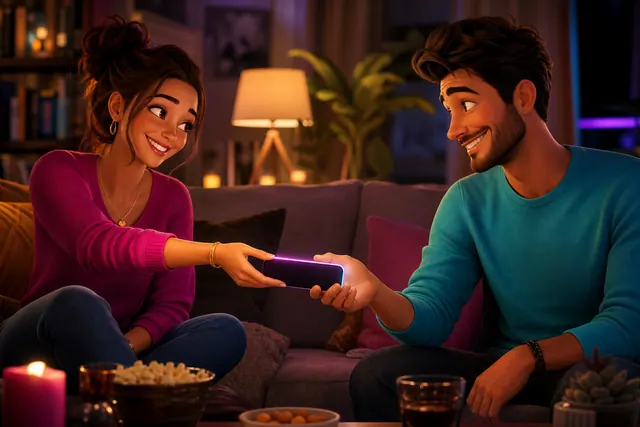
Draw or choose the same prompt without peeking. Send one link and everyone answers at the same time on their own phone, wherever they are; the moment the last answer is in, you get the score and the reading.
- Price
- Free, no ads, no sign-up
- Devices
- Any browser (iPhone / Android / PC). Take turns on one phone, or a link room for 2–8
- Best for
- Two people take turns on one device, or 3–8 join simultaneously with their own devices and an internet connection.
- Caution
- A room is deleted after 6 hours without use. One-phone mode works offline once the page is loaded; a link room needs Wi-Fi or signal.
Volume: normal (silent while drawing, one burst when the result lands). Two people take turns on one phone drawing the same prompt, 30 seconds each. When the first finishes, a hand-off screen hides the drawing, so the second person draws blind. Then the two drawings appear overlaid, with a sync rate that compares shape, placement and size, orientation, stroke style and rhythm out of 100, one of 71 written readings, and a seven-level relationship rank. Allow 5–10 minutes per pair and begin with three pairs in a group of six. Testing all 15 pairings would take much longer; prioritize a turn for everyone.
Use it during a time when phones are allowed. Load the play page while online, then keep it open for a shared-device session. The comparison is about similarity, not a drawing lesson, and the report titles are part of the game. See how MindMatch works for the full overview.
Free, no ads, no account. Pass one phone back and forth. If everyone has a phone, make a room and show the QR code to turn it into Group Sync for 3–8.
14. Secret words with a notes app
Volume: normal. A dealer uses a notes app to privately show most players “pancakes” and one player “waffles”. Talk for three minutes without saying the word, then vote for the odd word. The dealer knows the answer, sits out the vote and swaps roles next round. Paper slips work just as well.
15. Zoomed-in photo — “Guess what today’s photo is from a tiny crop”
Volume: normal. Open the camera roll on one phone, zoom all the way into a photo from today, and show the crop: lunch, a bus seat, someone’s shoe in the group photo. It only uses what everyone shared that day, so nobody is left out, and scrolling back through the photos is itself the best part of the night. Close-ups of faces only with that person’s okay.
16. Low-volume intro quiz — “Name the song from the first three seconds”
Volume: loud. Play the first three seconds of a song from one phone’s music app; first correct title wins. It works at low volume, but the moment someone gets it right is never quiet, so keep it before lights-out. Mix in the song from the bus ride and the one from the sports day playlist so it is not just a quiz for whoever knows the most music.
D. Everyone on their own phone (17–20): when there is Wi-Fi
17. MindMatch Group Sync — “Everyone in the room draws at once; the best pair is announced”

Volume: normal. One person makes a room in the browser and shows the QR code (a link or the six-character room code works too). Everyone joins on their own phone, and with three or more people the room automatically becomes Group Sync. The same prompt appears on every screen at the same moment: three drawing rounds, or five rounds of Image Choice (pick one of four pictures on instinct). Nobody sees anything until everyone has answered, then it all appears on every screen at once. Each round shows the best pair of the round, your best match and everyone’s drawings; the finale announces the most in-sync pair, the past-life-rival candidates, your average sync with the room and a compatibility map. The person who made the room moves it along.
With six players, all 15 pairs are compared together, which saves time over trying every pairing on one phone. Names are used for that room and room data expires after six hours without use. Each device can use its own language. The reveal may get noisy, so leave time for reactions before the quietest part of the evening.
The one requirement is Wi-Fi or signal. If the lodge has neither, switch to #13 and pass one phone.
18. Gartic Phone — “Write a sentence, the next person draws it, the next describes the drawing”
Volume: quiet. Gartic Phone (free, ad-supported, nothing to install) is drawing telephone in a browser: each person writes a prompt, the next draws it, the next writes what they think the drawing shows, and so on around the room. Drawing is individual, and the album at the end invites reactions. It can get lively, so schedule it before the quietest part of the evening. One room link, everyone joins.
19. skribbl.io — “One draws, everyone types the guess”
Volume: quiet to normal. skribbl.io (free, nothing to install) is draw-and-guess with typed answers, so it can be played without a word spoken. Make a private room, add your own word list from today (“the bus driver”, “the dining hall”) and it becomes a trip-only edition.
20. Kahoot! or JKLM.fun — “A quiz about today, answered on everyone’s phone”
Volume: quiet to normal. If one organized person creates an account on Kahoot! in advance and checks the plan’s player limit, ten questions about the trip (“what was the name of the ferry?”) run as a buzzer quiz on everyone’s phone, with a shared host screen or questions shown on players’ devices. No prep? JKLM.fun runs BombParty (type a word containing the given letters before the bomb goes off) in a browser with no account, and it is quiet because everyone is typing.
The 90 minutes before lights-out
| Time | The room | Game | Why |
|---|---|---|---|
| 90 min before | Showers done, everyone in | #2 Most likely to → #1 Telepathy game, three prompts | Everyone says something once; names stick |
| 75 min before | Peak energy | #6 Charades or #16 Intro quiz | Put lively games in the earlier free time |
| 60 min before | Settling | One phone: #13 MindMatch, rotating pairs. Everyone’s phone: #17 Group Sync | Save the result cards while there is battery |
| 40 min before | Ready to think a little | #14 Word Wolf or #18 Gartic Phone | One game, capped at 15 minutes |
| 20 min before | Voices coming down | #3 Two truths and a lie | One at a time; people can leave to brush teeth |
| 10 min before | Getting ready | #11 Highlights of the day | End games; brush teeth and tidy up |
| Lights-out | Rest | Games finished | Leave everyone time to sleep |
Ground rules so nobody has a bad night (say them once, at the start)
- Pass is always allowed. Any prompt, any game, no reason needed
- Nothing personal. No crushes, family, grades, bodies or money. “What happened today” and “what do you like” fill a whole night
- Don’t drag in anyone who wants to sleep. Before bed it is opt-in only, and the volume drops one notch near anyone who is asleep
- Forfeits stop at “you pick the next prompt.” No dares, nothing to eat or drink, nothing to do
- Ask before photos. Sleeping faces, silly faces and the picture-chain sheet all get a yes before they go in the group chat
- Finish at the agreed time. Agree on the finishing time before starting
- Fifteen minutes per game. Ending on time is what makes tomorrow’s “that was so fun”
What to keep for the morning
A trip night is twice as good when something from it survives to the bus home, the group chat and the back of the yearbook. These three are easy to keep.
- Result share cards. Save the result with the available share controls, and check with the people shown before posting it. Rooms expire after six hours without use, so save anything you want to keep during the session.
- The paper. Photograph the picture-chain sheet from #9 before someone takes it home
- The top threes from #11, typed one line each into someone’s notes app. Read a year later, who laughed at what comes back sharper than what you ate
FAQ
Phones were collected at dinner. Nothing in the room.
Sections A and B are twelve games that do not need a phone. Only #9 needs paper and a pen, and #10 needs one clock. The order #2 → #1 → #4 → #3 → #5 carries you to lights-out.
The lodge has almost no signal. Any phone games?
MindMatch’s one-phone mode (#13) works offline once the page is loaded. First open the play page while you still have signal, and keep it open. Group Sync (#17), Gartic Phone and skribbl.io need Wi-Fi or data, so on that night build the evening from A, B and #13.
Which games work during quiet time before bed?
All five in section B (#8–#12), plus #5 Converge and #7 the scary story. Completely silent: #9 picture chain and #10 the one-minute guess, and at a home sleepover where phones are fine, #18 Gartic Phone and #19 skribbl.io.
One of us is shy.
Push the games that put one person in the spotlight (#6 Charades, #3 Two truths) to later, and start with the ones where everyone answers at once: #1, #2, #17. MindMatch scores how alike two drawings are, not how good, so you do not need polished drawing skills.
Does MindMatch need an app?
No. It runs in the browser, free, with no ads and no sign-up, and iPhones and Androids can share one room. There is also an iPhone app if you want your results saved.
How many games should we plan?
Two or three before lights-out is a useful starting point. Leave time for ordinary conversation and getting ready for bed.